Thursday, 28 May 2015

Lovely Lilacs


One morning, not long ago ... one of our friends ambled off the bus and presented me with a lovely bouquet of fresh lilacs! They were a lovely surprise, as the tree in my back yard had not yet blossomed. Of course, on the drive home it's all I could see! Lilac bushes were in bloom EVERYWHERE! How had I NOT noticed? My friend had given me a silent reminder to take time and smell the flowers.


I had already thought that the vase of lilacs would make a great provocation in class the next day. I suspected that the scent alone, would attract a following. But as I drove home, I felt that it would be important for the children to have a guided inquiry and really NOTICE the details of the lavender coloured lilacs that were popping up like weeds across the rural countryside.


With the wheels set in motion, the tables were assembled and ready. As a class, we took the time to really observe the lilacs. We noticed the petals. Specifically, we observed the shape, and the number that made up a blossom -- 4. We noticed that the blossoms are comprised of varying shades of purple. We noticed the shape of the leaves -- they are shaped like hearts. And the smell was amazing!


The children were excited to grab a paint brush and get started. They wanted to be scientists and record their data! There was some explicit teaching that took place at this point, and the artist were given direction to use a sponge to create a dark purple shape on their paper. Because the shape was to be the backdrop for the blossoms, we observed the shape of each bunch, or stem of lilacs. We decided it looked like a triangle or a hat.


Ready to add details, we remembered that the blossoms consisted of 4 individual petals. They looked like an 'X'. What could we use to paint the petals? It was decided that they could use a small paint brush, or a Q-tip. White and purple paint were delivered to the tables and the children leaned in to mix the colours, interpret what they saw before them, and record -- with flourish!


Lilacs continued to come in, and we thank you for contributions to our atelier. With one "lesson" under their belt, the bouquets were an attractive and compelling provocation.


The paintings are each a beautiful representation of what the children saw in nature. We marvel at them daily, on display in our classroom and our school foyer.


Thank you for taking the time to smell the flowers, and visiting the atelier!


Novel Nests

During one of our walks in early spring, we went out to explore the changes taking place before our eyes. Snow was melting. Grass was turning green. And the birds were returning from their migration.

The buds weren't yet coming out on the trees, and we discovered that we could see bird nests nestled in the shrubs. Because the nests had been abandoned and left to the elements, they were falling apart. And of course, the question we all waited to be asked emerged : What are nests made from?


Back in class, we broke into our focus groups and examined what nests were made from. We just happened to have a collection in our science centre.


As a large group, we shared our findings. And the inspiration flowed... Would the birds like us to build a nest for them? Could we build a nest? Could we help birds make a nest?


We noticed that the other nests contained some fabric. In lieu of fabric, we wondered if  yarn would be a good a good material to build a nest with? One of our parents had kindly made a donation. We made our way back outside and left a gift for the birds. Our hope was that the birds would make good use of the yarn when they returned to make new nests and lay their eggs.


Time passed, buds grew on the hedges, and we returned to the same spot to see if the yarn was gone. To everyone's delight, we noticed that there was a nest in the tree!


We approached the honey locust tree cautiously, so to not scare any wildlife. What we discovered inside the nest was beyond exciting!


This got us excited about nests, once again. We collected the materials necessary to build nests, and got to work!


The grass, corn cob material, leaves, small twigs, fabric, clay, mud, garbage, and the sort, were dumped on the table and sifted through. Some paper pulp (leftover from our paper making project) was added to the mix, and we attempted to contain the mess to a bowl.


When the mix was just right ( not too runny, and not too thick ), the children picked up a gob to cover an upsidedown apple sauce container. 


The old screens that were utilized for the paper making project were used again for the nests to dry on.


Upon closer examination, the inside of the nests weren't very cosy for an egg. We went out on another excursion to find some "soft" materials to line the nests. Our Chief Custodian nearly panicked when he saw the whole class marching towards the the classroom door, each with a fluffy cattail in hand. 


While assembling the nests, the children were asked what birds would think of the nests. 

"It's going to be nice and comfy."
"They'll think it's fluffy."
"The birds will be comfy and out of the wind."


This project is ongoing, and we are in the process of determining the best way to transport the cozy nests home. We have a few ideas up our sleeves, so stay tuned! Also, we need to go on another excursion to observe the bird that hatched from the nest we discovered in honey locust tree!


Thanks for visiting the atelier!


Friday, 17 April 2015

Sugaring off Season

Proulx Maple Farm

Full Day Kindergarten has been full of new beginnings for the little ones, and for educators. We planned our first field trip this spring, and braved the prospect of ushering 4 year olds into "porta-potties". Never, in a million years, could I imagine embarking on this journey without the help from volunteers. I am truly grateful! Thank you!

Around the time we first started planning the trip, I was in my local hardware store and spotted the supplies needed to tap your own trees. If we had mature maple trees on our yard, I would have attempted to try our hand at it. Nonetheless, I picked up those supplies and brought them to class to pique their curiosity. Mission accomplished.

Demonstrating how they think the
bucket hangs from the tree
Exploring the spile
We read a few books on the topic of sugaring off, and were surprised to learn that it takes 40 buckets of sap to produce 1 bucket of yummy, golden syrup. 

40!

That's a big number! We took time during Focus Groups to explore that number.
Counting out 4 rows of 10 

Counting to ensure there are really 40
Using tens frames and bottle caps to count to 40.
Using blocks & tens frames to represent 40
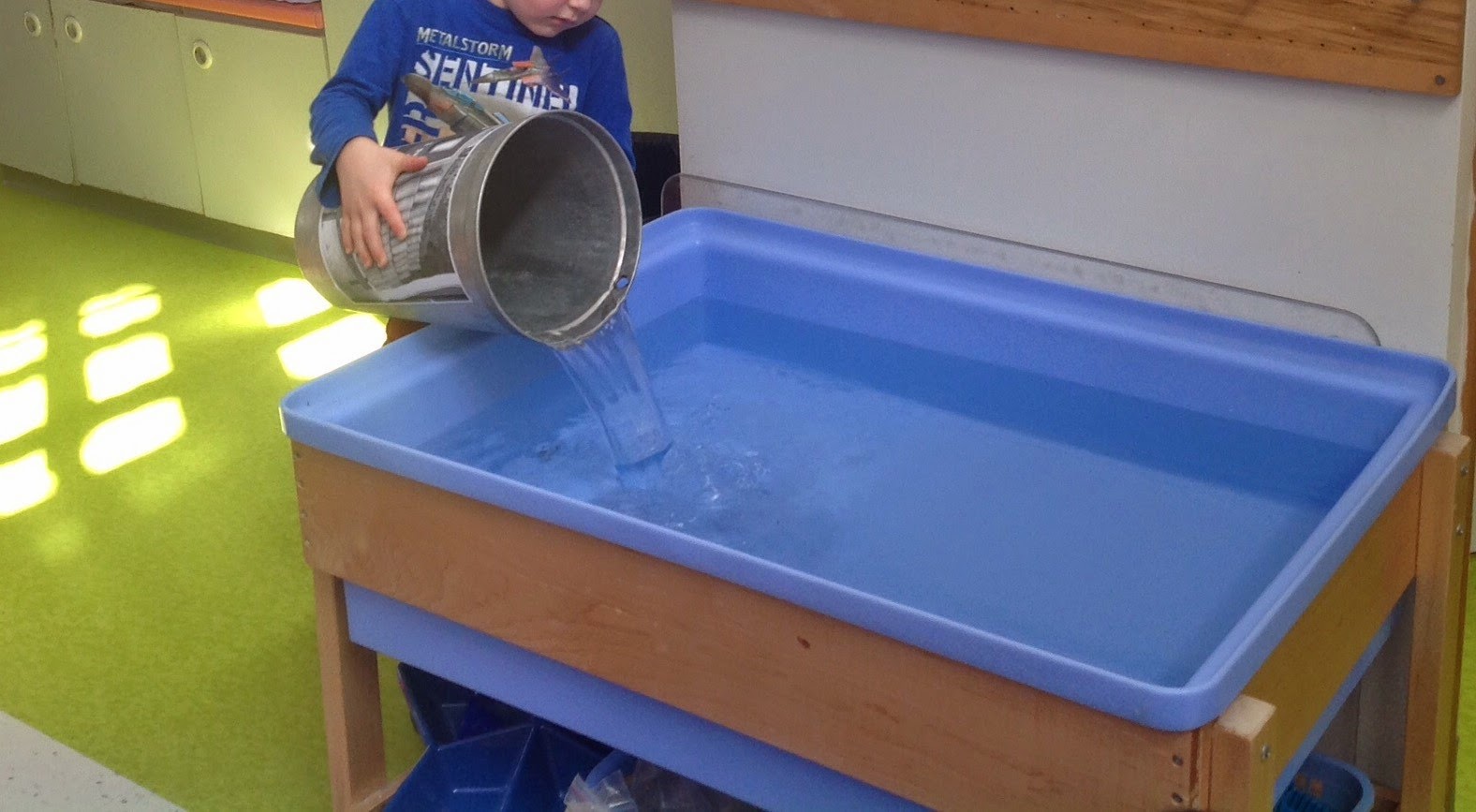
Our learning carried over to the water table, where it magically turned 
into an "evaporator".  We wondered if the "evaporator" had the 
capacity to hold 40 buckets worth of sap. 
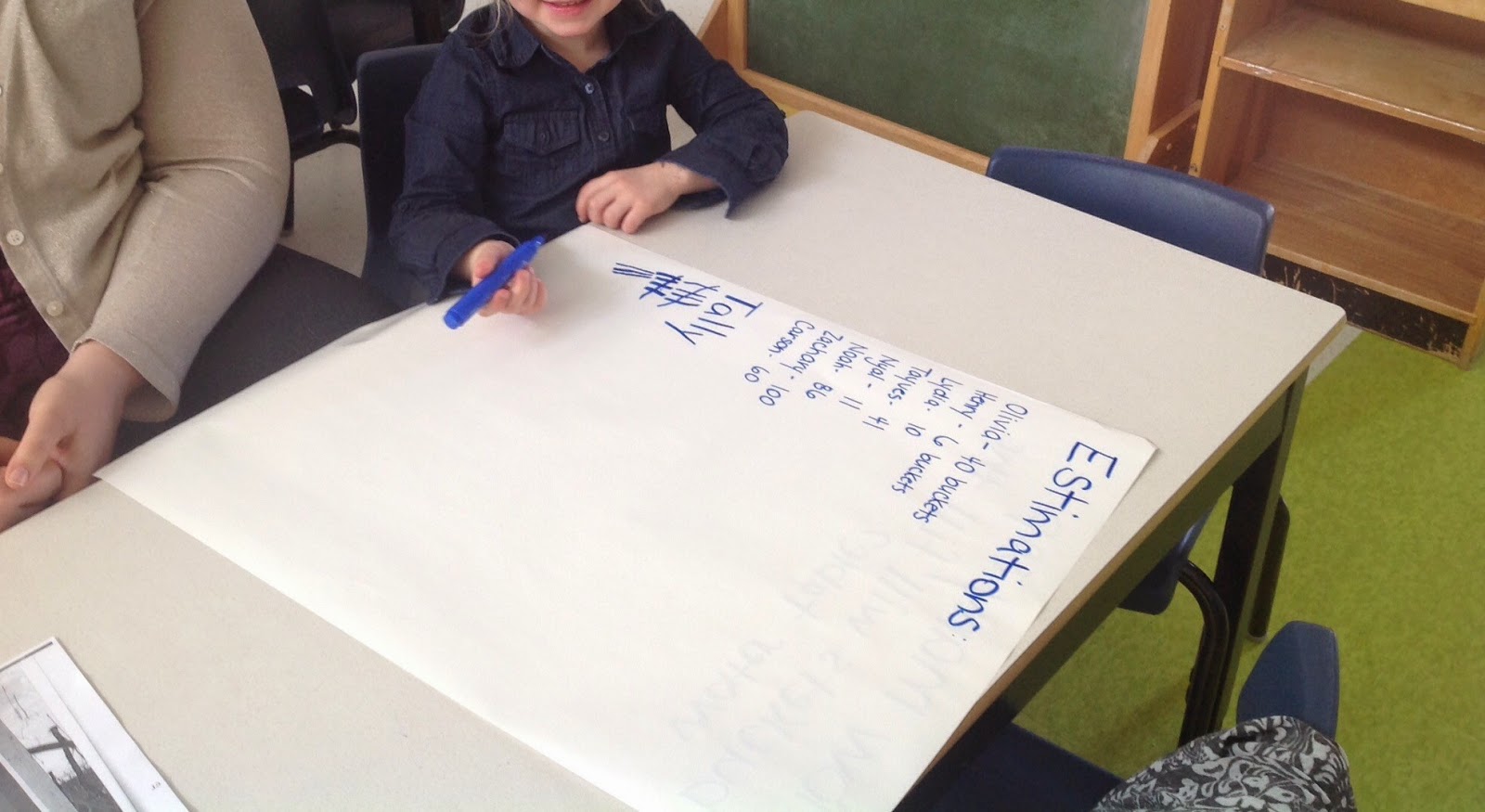
Estimates were recorded, then we explored!

Literacy & Numeracy at play
That's a lot of "sap"!
How do we get sap flowing through the spile?
Taking a tally during centre time
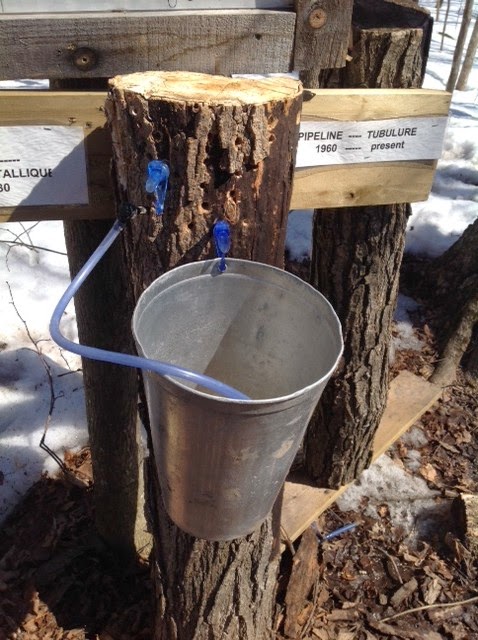
By the time our field trip rolled around, the children were so excited. Proulx Farm had a lot to offer! A presentation outside identified the way sap has been collected throughout history.


Left (large wooden spile and bucket out of a log)

Right (small wooden spile and bucket out of wood)


Left (metal spile and bucket)

Right (plastic spile and aluminum bucket, OR tubing running from tree to tree)
 A tour inside of the sugar shack demonstrated how the sap is boiled at a high temperature in an evaporator, and syrup is produced. The smell was heavenly! We could smell the wood smoke as we approached, and from within, there was a sweet aroma!

Rustic "Sugar Shack" 

Evaporator at work
Steam rising up, beyond the rafters
A connection was made to the water cycle (evaporation) as we watched the steam rise up and out of the building. 

It was a full day! We enjoyed our pancakes and smothered them in delicious maple syrup - what a treat! Then we took a wagon ride back to the play structures and animal barn. A few of our little friends fell asleep on the bus ride home. What a terrific first field trip, and sugaring off season!

Thank you for visiting our atelier.

Thursday, 16 April 2015

Building Bridges

  As the thaw sets in, spirits soar on the school yard. The landscape changes and promises new opportunities for discovery and routines. After several days of slushing about, the small puddles on the yard expanded and engulfed the sand pit. While I usually am one to endorse messy play and exploration, there are some drawbacks, such as not being able to dry off properly at school. Complaints (about getting back into soggy clothing and getting splashed) evolved into class meetings, and new rules of play took shape.

One little friend; in an attempt to provide a solution to the mud puddle dilema, declared, "We need a bridge!"  There was much agreement, and from here, the dayplan was abandoned and we went in an entirely different direction. The inquiry was born.

How can we make a bridge? The children named their choice materials: wood and rope.


We mused outloud, "How about a pallet?" When it was suggested that we could inquire with Mr. Jeff, excitement rose. As luck would have it, Mrs. Jeff had just taken a sturdy one out to the dumpster and he was more than happy to retrieve it for us. Even before we could get our boots on, a pallet was delivered!


In the meantime, we shared the story of "3 Billy Goats Gruff", and our focus group explored bridge building. The children were encouraged to look around the room and devise a plan to create their own structure to bridge their construction paper "mud puddle". The results, we share below. 

Rulers and Kapla blocks


Big blocks


Unifix cubes

Assorted foam and red wooden blocks

The next series of photos were taken in absolute silence, as this child explored simple physics and created a "see-saw", or lever, for a bridge. I love how the pictures capture her learning as she discovers how the load effects the lever. The beam (ruler) pivots when she removes dinosaurs (weight/effort) at the opposite end.

The beam is set, with a dinosaur as the fulcrum.

The dinosaurs are loaded on, one by one.

Dinosaurs keep marching on, trying to cross the puddle.

The load at the other end is gradually removed.
The beam finally pivots and allows the dinosaurs
to pass over the mud puddle.

The children continue to develop and apply their knowledge and understanding of bridges. While travelling by bus on our recent field trip, some children excitedly pointed out an overpass. On a excursion around our yard, we encountered a bridge near a runoff culvert and crossed it. The opportunities to explore bridges has not passed - we continue to build on our knowledge and expand our understanding and appreciation. We are "building" our schema.

Wooden poles used to create a bridge 
over corn field run off in the junior yard.

Thank you for visiting the atelier.