Showing posts with label Show & Share. Show all posts

Friday, 11 March 2016

Superb Soup


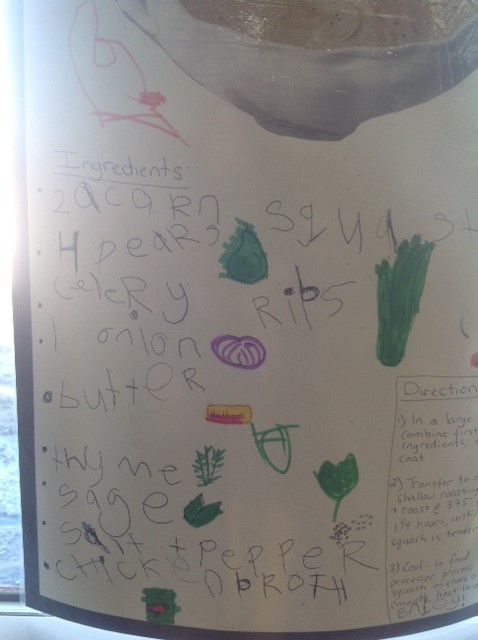
There is nothing like a warm bowl of soup on a cold winter day. We had been hearing a lot about the homemade soups the children were enjoying at home, and they inspired a recent "show & share". Families were invited to send in their family recipes, with "kid print". It was a pretty open ended challenge that encouraged the children ...


To play.
To explore.
To observe.
To create.


Many took us up on the challenge, and the children proudly shared their stories and recipes. These recipes were then featured in our kitchen, and inspired the little chefs at play.


Inspired by all our talk about delicious and hearty soups, families were also invited to send in empty soup cans (clean & without sharp edges), to use at another centre.


This centre presented many opportunities for the children to be creative and write as they designed their own soup label.


The ingredient list and directions were scribed for the children. They focused on sequence and told us what they would like written down. We modeled and drew attention to how words are sounded out, how spaces are placed between words, and how different texts forms and features are organized.


The choice of soups in the kitchen keeps growing. And it's healthy!


Thank you for sending in the recipes and empty soup cans. Your support is far reaching.

Thank you for visiting our atelier.

Monday, 9 November 2015

Buoyancy

The children are settling in so quickly, and each day a new centre for exploration is introduced. We wanted to get the JKs started on the water table earlier this year, and we were inspired to call upon our families to help. We asked that the children bring in an item from nature to "show & share" with the class, and release into the water table.

We had predicted that buoyancy would be an outcome. One of our driving questions was, "Do you think it will sink, or float? Why? Explain your thinking." ( ... or some variation of this inquiry). And true to their own curiosity, the children made observations.


"The apples float."

"All the rocks sank."

"The leaf floats. Now it's sinking!"

"Yesterday the cones were floating. Today they sinking."


And more exploration occurred...


"When the rock is ON the leaf, it sinks."


"When the cone is on the leaf, it sinks slowly."

When attempting to explain their understanding of buoyancy, one child predicted that a stick would sink, "Because it is heavy." They were surprised when it floated. We determined that weight is not the only determining factor for buoyancy.

While exploring at the water table, one of the children noticed that the pine cone had undergone some changes. At this point, the pine cone had been in the water for about 30 minutes when he said, "The things are coming up."


I had to ask some more questions to get to the bottom of what he was saying. The 'things' were the scales of the pine cone. I had to look that up! I did not have the vocabulary for the spiny parts of a pine cone, until that day! Scales. They called 'scales'. [ More on this in a later post ...]


We continued to predict, and explore. We recorded our data, and called ourselves Scientists.


I continue to be amazed at the insights and the connections made in class. One activity can branch out, and lead us down several different paths. From this buoyancy experiment, we were led to explore the many materials and items that come from trees. There is never a dull moment at the atelier!


Thank you for dropping by! It's good to be back!


Monday, 20 October 2014

Colossal Collections!

............ I wish this season could stretch ...........
I wish that the changes we are witnessing could last a while longer.

The children taking a moment to take in the
fresh scents of autumn by our pond

Thank you so much for sending in pressed fall leaves that you collected on your walks. We marveled that each collection was unique, as were the methods of pressing and preserving these little gems. The children have been so proud to bring them in, and we put them straight to "work".  The first collection which was presented last week, provided the initial inspiration for one of our bulletin boards. The leaves were pressed in three separate sheets of wax paper, and labeled with "kid print" : oak leaves, maple leaves and basswood leaves. When the next presentation was made, the children identified the "Canadian" leaves (maple), and it was suggested we put them all together. The children were identifying shape as a feature of their collections, and so the bulletin board emerged.

"We can sort by shape."

Four categories were created "on the fly" - leaves that look like the have little fingers similar to the oak leaves, leaves that are more rounded like the basswood leaves, leaves that have points like the maple leaves, and leaves that look like feathers. Over the coming days, more leaves came in and we added to the bulletin board, allowing everyone a chance to contribute.

 In our focus groups, we took the remaining leaves and brainstormed other ways that we could sort our collections. The process engaged the children and the morning flew by.

Sorting leaves by colour


Creating a "rainbow" of leaves


Another "rainbow"


Our second bulletin board that documents
the childrens' sorting collections

And then there was the MASSIVE leaf that was presented. Compared to their little hands, it was a shocking size and begged to be displayed. As the leaves came in, we sorted from largest to smallest, featuring maple leaves.


Part of the leaf sorting process

After sorting their leaves, one of the focus groups were inspired to make a long leaf train. That's a lot of leaves! How long is it?


The children use link-its to measure
 the chain of leaves

And once we had exhausted the leaf sorting activities, the paints came out. Brushes were dipped, and colour was applied. We did a water colour painting of maple leaves, focusing on one leaf at a time. We paid attention to the amount of paint necessary to add pigment to the paper. We replicated a pencil grip, using our brushes.

Water colour painting on dry paper


This activity was a precursor to a painting activity completed a few days later. The children had lots of "hands on" experience with the leaves at this point, and had observed the contours of the leaves, the colours and the veins on each leaf. Our next activity incorporated these observation skills and replicating the symmetry we observed. They were presented with a piece of paper, on which was only half of a leaf. Being fully aware that our little people are still developing fine motor skills, we encouraged them to take a risk and try their hand at tracing the other half of the leaf in pencil. Admittedly, we did not know how this would turn out. Both teachers and students took a risk with this one. The next step was for the children to pick up their paint brushes and interpret how the other half of the leaf would look. The results are amazing. 


So many curriculum expectations were covered. We touched on mathematics, literacy, science and social emotional needs. Creativity was employed, and critical thinking skills were exercised. We cannot thank you enough for sending in your collections! It is wonderful to witness the children engaged in "play", using natural materials.


Counting with our fingers, the children can
"read" this poem

Thank you stopping by our atelier!

Friday, 17 October 2014

Little Tree Huggers!

" Study nature, love nature, stay close to nature. It will never fail you. "
~ Frank Lloyd Wright

Inquiry : How many children does it take to form a circle around the tree?

Earlier this week, we took advantage of the remaining warm and sunny weather and head for the field to go exploring. There was no specific outcome planned. We simply needed to use our skills of observation.

We were intent on listening. What would we notice?
We were intent on watching. What would we notice?
We were intent on smelling. What would we notice?
We were intent on feeling. What would we notice?


We noticed that some trees have leaves, and other trees have needles.

"It doesn't have any leaves."
"It's a little bit darker on the skin."
"The bark."
"That one has pointy sticks on it."
"Branches."
"Branches grow leaves."
"The tree is so big and has lots of branches."
"The leaves fall off and the trees are naked."
"Leaves are for summer."
"Leaves are for the birds."
"One has changing leaves and one doesn't."
"The other one has needles."


We spoke to the differences between deciduous and coniferous trees, and asked the children if they think the trees will look the same next week?

In reference to the leaves, one little person said,
"If they're still on - they may change. They'll look red." 


I had anticipated that we would make our way around the entire yard, but our adventure took an unexpected turn. Someone tripped. They were ok, and many friends stopped to help him up. But they wondered, why did he trip? Remember, the little things are the big things in kindergarten. They notice, and they observe... 

Roots growing out from the base of a tree = tripping hazard.

 We spent a l-o-n-g time checking out the roots in this part of the yard, and didn't move beyond this point until it was time to come in.


"There's logs coming out of the tree."
"The grass is growing up to cover the logs."
 "It's like a log, but it's not."
"It's connected to the other tree."
"They're roots."
"You can step on the roots."
"It reminds me of a river."
"Maybe the roots are making the leaves fall off the tree."


 Our nature walk was a 'jumping off' point for a number of follow-up activities. We did some yoga - 'tree pose', and tested our balance, comparing it to a tree swaying in the wind. Our 'limbs' helped us balance. We spoke to the function of roots, and how they provide nutrients to the tree, ensuring its survival. We read a story, The Tree, written by Dana Lyons & illustrated by David Danioth. It is a personal experience narrative, told by an ancient tree on the west coast. The story highlighted the fact that trees are homes to birds and other wild life, and its roots hold back the river banks. Towards the end of the story, the tree expresses its gratitude for the children who embrace it, and the wind which carries its song.


This got us talking about the sounds trees make and how they communicate. This conversation was fascinating, and I got caught up in the "I wonder ..." discussion, momentarily forgetting that ideas were coming from 3 & 4 year olds. This alone, could be a separate post.

We were also inspired to pick up our paint brushes again, and create another collaborative art work, in the form of a mural. 


Just the basics (grass, a few outlines, and a couple tree trunks) were prepared on the mural as a provocation... 
To play.
To explore.
To observe.
To create.  

Ideas are shared, and details emerge.
  

A view from above - above ground.

Roots are added, showing an "underground" perspective.


You can imagine my delight, when, one of our friends shared a little "root" vegetable from their garden! How timely, and how wonderful.


These two little carrots reminded us of the roots we explored on our nature walk! And I was reminded of how we are all interconnected. The beauty of nature fills us with wonder.

Thank you for visiting the atelier.