Friday, 31 January 2014

No Two Alike


Many of our "tangents" seem to stem from experiences, song and literature. This one is no different. I shared a story ordered through a recent Scholastic book order, titled: No Two Alike, written by Keith Baker.


It follows the path of two birds through a winter landscape and touches on the similarities that we see in nature, and the differences that make each natural thing unique. Though there are more snowflakes than we can count (we tried :), no two are alike.

Images of snowflakes were then studied - what beautiful crystals!

                                   "Thank you"                                       "Imagine" (John Lennon)
Images of ice crystals by Masaru Emoto


We also created patterns with foam snowflakes.


In lieu of a light table, we used an "old-school" 
overhead projector and traced their outlines.

But we kept coming back to the images, and we found it hard to believe that no two could be exactly alike.

Love & Gratitude, Masaru Emoto


Then we got crafty. It was time to make our own crystals. 
With our supplies ready, we became little scientists.

We manipulated pipe cleaners to make a design with 6 points. Remembering that the star in the centre of our apples had 5 points ~ our snowflakes would have six. It was a tricky task manipulating and bending those pipe cleaners!  Make an X, bend one end over, etc...


Borax was added to warm water and we watched the Borax dissolve in the water.
 Then, we suspended our pipe cleaner snowflakes in the solution overnight.
(4 tbsp. borax per cup of water)

              A six-pointed "snowflake"                                         Borax crystals have formed 
              in a solution of Borax                                                    on the pipe cleaner
             and water.                                                                            overnight.


When we studied the crystals up-close we all agreed that no two were alike.

An individual "snowflake", covered in borax crystals. 


Borax crystals on display with our collaborative
painting, "Snowy Day" as a backdrop.

Thank you for visiting us at our atelier.


Saturday, 25 January 2014

The Story of Water


The extremely cold temperatures have put a damper on our outdoor play, much to everyones' dismay. The children have had indoor "recess" a lot in past few weeks, but it has not prevented us from playing with the snow!

 
The sensory bin was filled with snow each morning, and begged for
warm fingers to take the plunge and explore. Aiy-yi-yaiy!
 
 
As the morning progressed, and many pairs of hands passed through the bin, the snow started to change. They discovered that the snow became more malleable. And later still, "Hmmm. There is water." 


"Hey!  Now we have two water tables!"
 
Our study of water has been multi-faceted. Thank you for sending in your interesting and shaped containers for "show & share". We gather around the water table and explore capacity, and predict which containers will hold more or less water. The children have also been predicting how many caps of water it will take to fill the containers.
 
So as we studied the states of water (liquid and solid), the children also noted the streaks of water left behind on the table when wiping up after snack.
 

Writing our names in the water on tabletops.
 
But then they wanted to know why the table didn't stay wet. I heard the critical thinking and grabbed a pencil and paper.
 
               "Where did the water go?"
              "It's drying. That's what happens." 
              "I think its in the table."
 
 Our follow-up discussion related to the steam we saw rising from the kettle when making our Borax crystal snowflakes, and the fog we see when we talk on a cold day. (No shortage of those lately:)
 
The take-home lesson for the day:
Water can be found in 3 states ~ liquid, solid or a gas (water vapour).
The water didn't soak into the table - it evaporated into the air. We can't see it, but it's there.
 
FUN APPLICATION TIME ~ what happens when you combine water, food colouring and an ice cube tray?


With the help of my friends, we coloured some water and
poured it into the ice cube tray.


The tray made it's way to the freezer in the staff room and
clothes pegs were added once the water started to turn into a solid.
 
 
And our provocation was ready for the next day...


To play.
To explore.
To observe.
To create.
  
The children "working" on their individual "paintings"
using the ice cubes (water as a solid) that they created.


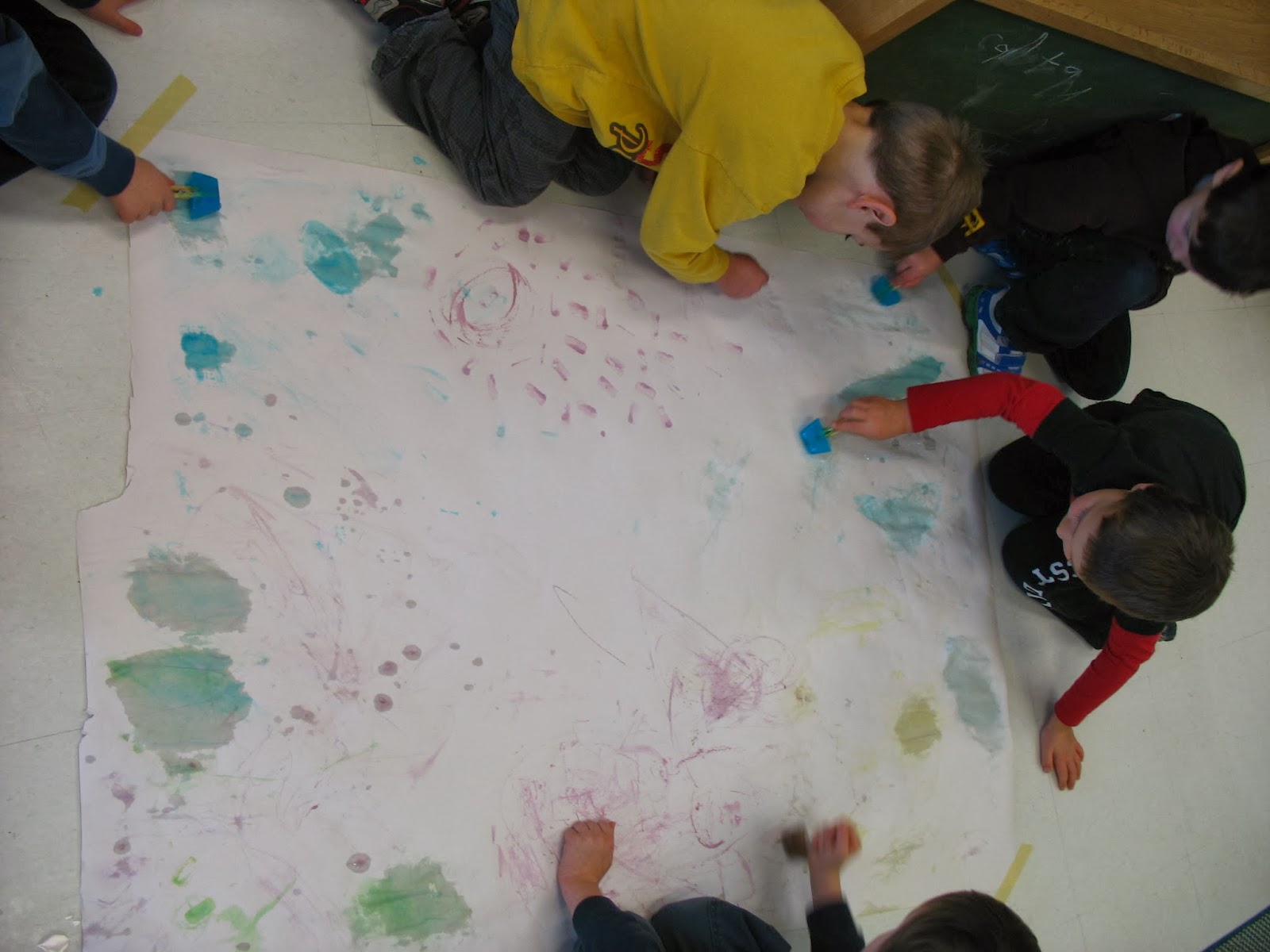
The children "working" on their collaborative mural
using their ice cubes.
 
 
And what happened to those pools of "paint"? They were there yesterday.
 
That's right - if its not a liquid, and it's not a solid, it must be a gas.
 
EVAPORATION was the word of the day, and continues to be, as we explore with more of our "wet on wet" water colour paintings.


Thanks for dropping by our atelier.


Friday, 10 January 2014

Sky Spirits


Happy New Year to all! I am quickly writing this little update to fill you in on some adventures we had this week. In eager anticipation of the northern lights, science experiments linked to states of water were put on hold. We watched a video and gazed in awe of the colours that danced in the sky. We also read a beautiful personal experience narrative titled: Sky Sisters, written by Jan Bourdeau Waboose and illustrated by Brian Deines.


This Ojibway story tells the tale of two sisters who journey up a hill to get a view of the Sky Spirits (northern lights). The magical experience of lying in wait and seeing the light show connects them to their mother and auntie who made the trek before them, and to the Sky Spirits who seemed to wave to them from above. In the words of their Nokomis, "Wisdom comes on silent wings," and while quietly taking in the lights, the sisters make another connection in the stillness and call the Sky Spirits "Sky Sisters".

We responded by grasping ribbons and dancing around the room, as we waved, and twirled and rhythmically let our ribbons flow through the air.


Thinking that northern lights would truly be visible to us, we prepared a backdrop to paint a collaborative mural.


And while it was a disappointment to many (me especially!), we continued with the mural as planned, and used the art from the book, and the video we watched to inspire our mural. First, a chalk line was made in waves to replicate the flow of light. Then pastel paint was created by mixing colour with white tempera. The children traced over the chalk line, leaving a good amount of paint on the paper. Another child followed behind the wet paint with the "dry brush" and swept the paint in an upward motion. This process was repeated for each ribbon of colour.


While many of the children have yet to truly experience the wonder and magic of the northern lights, I know that it will stay with them a lifetime when they do. And for a fleeting moment, maybe we did experience them here in the classroom - at play with our paint brushes and our ribbons.

Thank you for visiting our atelier.


Saturday, 14 December 2013

Don't Eat a..... POINSETTIA!


Recently, I lugged in some boxes from home labelled, "CHRISTMAS: SCHOOL". I always rejoice in opening up storage/decoration boxes at home, revisiting little treasures that I put away and forgot about. The same holds true for the boxes that I open for school.

 
I pulled out my potted poinsettias, "Olde World" Santa, door wreath, and nutcracker. I am making a conscious effort to not overdecorate with commercial items, and allowing the childrens' work to take centre stage. However, knowing that some symbols are important for developing schema, I decided to introduce the poinsettia. And so the arrangement sat at a table, summoning the children...

To play.
To explore.
To observe.
To create.


Their master pieces continue to fill the room. And without giving too much away (you'll see at the concert :), the children connected with the plant through song and fine arts.


I'll admit that I didn't fully draw their attention to the shape of the leaves each time, but some did notice that the green leaves were similar to the red leaves, except in colour. It was decided that it is really just a leafy plant, with leaves of red and green. And yet, maybe the red ones are the petals?(They were divided). What we all agreed upon - they are not for eating!


Something else I noticed (seen in the bulletin board display) is that a few children chose to not directly represent the poinsettia itself, but have created something akin to wrapping paper patterns, using the colours RED, GREEN, and YELLOW. So, while not representing the plant itself, their connections are documented too. Poinsettia, wrapping paper. Symbols of the season, dear to them :)

 
Thank you for visiting our busy atelier!


Wednesday, 11 December 2013

The Setting Sun


It was wonderful to reconnect with families this past month, and reflect on the progress and milestones that our junior kindergarten children have met. And yet I know, there are still so many questions that weren't asked and perhaps not answered. I am only too aware that your little ones are never far from your mind. There were reports from some families that they are looking forward to the day when there is more of a daily conversation at home, about the highlights of their child's day. I can relate, and I hope that this blog can be viewed with your children as a prompt.

This blog has been tailored to reflect more about what is the current interest in the classroom, as opposed to "what we will" learn. With the changing pace of kindergarten, I feel it is important to share some of the guiding principles in our classroom. The "emergent curriculum" is drawing the attention of educators across our school board.

And so we ask, "What is emergent curriculum?"

(excerpts taken from pages 17 & 18 : Susan Stacey, 2009, Emergent Curriculum in Early Childhood Settings)

- In its practice, the teacher takes the role of facilitator, taking what they see and hear, and bringing to children the opportunity to discover and construct further knowledge

- It enables childrens' learning and teachers' thinking to be made visible through varied forms of documentation

- It is flexible in that curriculum planning, rather than being done well in advance, is constantly developing.

Traditionally, I have outlined our future units (e.g. migration, hibernation, adaptation). Please be assured that I still have these ideas in the back of my head, though I am making a greater effort to listen to the childrens' ideas and allow this to lead and inspire my instruction as we journey through the year. For this reason, you will not see me pinpointing exactly what we "will be learning" in advance.

While on our nature walks this fall, the children made observations about the Canada geese traveling overhead. With their interest sparked, we took to the books. (A daily read-aloud is still part of our emergent curriculum :) We compared the Canada geese to the Snow geese on a Venn diagram, moved to the "Migration Dance" and explored images - many of which were sunset images.
*courtesy of flickr*

From here, another art project was inspired. And while the children sang the alphabet in French, I took the opportunity to set up a water colour provocation with the intention...

To play.
To explore.
To observe.
To create.


Some care was taken to demonstrate how to create "wet on wet" water colour. With our paper fastened to the tables, the paper was prepared with water. With a  jar of plain tap water and a brush, long sweeping brush strokes were practiced, taking care not to disturb or tear the fibres of the paper.


With broad paint brushes, the children set to work, applying water colour to their wet paper. The children marveled at how the colours ran across the page and made little puddles.


Perhaps because the children are now accustomed to cleaning off the tables, many were concerned about the paint that was pooling on the paper, and drips that were on the surface of the table. They had to be reassured that this was fine :)


The next morning, they were delighted with the colours that remained on the page. Eager fingers reached out to touch the paper, and several shared their surprise that the painting was no longer wet. Perhaps because the pages were so significantly saturated the day before, they wondered...

Where did the water go?
This is very likely a question (and concept) that we will revisit, time and time again this year. Each time the children experience it, their schema becomes broader. When I probed some of the children for their responses to this question, their thoughts and ideas were recorded:

"It dried up."
"And now it's painted."
"It's under the paint."
"I don't feel any water under there." (feeling under one of the pictures)
"It went into the paper."
"Maybe it went away."
"It goes outside."
"It disappears like magic."
"It's in the sun."


 I look forward to revisiting this science concept as the winter snow trails in,
(and our daylight time gets longer!)
In kindergarten, we keep on "building" at our perfect pace :)

Thanks for visiting our atelier.


Monday, 11 November 2013

In Flanders Fields


This learning opportunity began a while back, with a reading of the story, "The Crayon Box that Talked". It is a story about a box of crayons who sit on a store shelf and bicker. A little girl overhears their conversations, takes pity on them, and brings the box of crayons home. She proceeds to take each crayon out of the box and use them in her beautiful creation. In the end, the crayons all stand back and admire the picture. They realize that together they have worked together in harmony and developed an appreciation for each other's unique qualities.  

 
Connecting the Dots:

You may be wondering how this book is connected to In Flanders Fields. While seemingly unconnected, the message in the story seemed to fit with Remembrance Day. Without going into too much detail about Remembrance Day at this developmental stage in their life, my emphasis is put on working together, taking care of each other, and valuing our unique qualities.

While reading the story, a connection was made to the "Yellow Collage" created by the class during our first month of school. It is an example of how they work together, and appreciate each others creativity. Brilliant.

My plans for introducing the symbol of the poppy through art was inspired on the spot via their connection, and the project evolved. Another collage, and collaborative effort was coming together.

Materials were prepared: tissue paper, graphic/visual inspiration...

...including the famous poem written by Lieut.-Col. John McCrae
In Flanders Fields


 Step 1: The children collaborated and glued the poem/musical score
as backdrop on the "canvas".

Step 2: Tissue paper petals of red, pink and orange overlapped
each other to create poppies. The different colours created dimension.

Our field of child created poppies.

Step 3: The teacher collaboration piece included the greenery.

We brainstormed ideas for the inside of the poppy. My initial thought was to use black pipe cleaners rolled into spirals. Someone suggested paint. And someone else was playing with the seed pods on the floor behind them. Seeds. Pods. Aha! Of course! The centre of the poppy is a seed pod. And the fact that they are actually hosta seeds doesn't really seem to matter, does it? We made connections and were inspired by nature, once again. Life is beautiful.


Step 4: The seeds are glued to the centre of the poppies.

The childrens' collage, titled: Flanders Fields, served as backdrop for our Remembrance Day ceremony this morning. And I am reminded of a quote,

"Art can function as a bridge to understanding others as well
as ourselves. To become comfortable with the creation of art is a
vital step toward healthy, tolerant consciousness."

 Poppies in Flanders Fields are a backdrop for the 
school choir during our assembly today.

Thank you for taking a moment to visit our atelier.